
Why autonomous delivery needs durable workflow state
AI agents are going to create, triage, comment on, assign, escalate, and close work.
That does not mean they should operate a project management UI.
Browser automation is useful when there is no better interface. It is a poor foundation for production workflow. Screens change. Buttons move. Permissions are implicit. Retries are awkward. Audit becomes a video of something clicking through a tool rather than a durable record of a state transition.
Autonomous delivery needs workflow state that behaves like infrastructure.
That is the practical case for RustGrid’s durable mission state. The underlying ticket contract is not merely a card on a board. It is a workflow object with identity, status, priority, description, comments, fields, watchers, permissions, history, and events. The UI is one client. An agent is another client. A backend worker, support console, customer portal, and incident system can all be clients too.
For AI agents, that distinction is not aesthetic. It is the difference between “the model clicked something” and “the system accepted a valid workflow transition from a scoped actor.”
RustGrid Turns Durable State Into Execution
RustGrid’s Control Room is the visible operational surface for this capability: missions and agent runs backed by real projects, durable events, repository bindings, webhook visibility, and API calls.
The live RustGrid application is here: agentops.rustgrid.com.
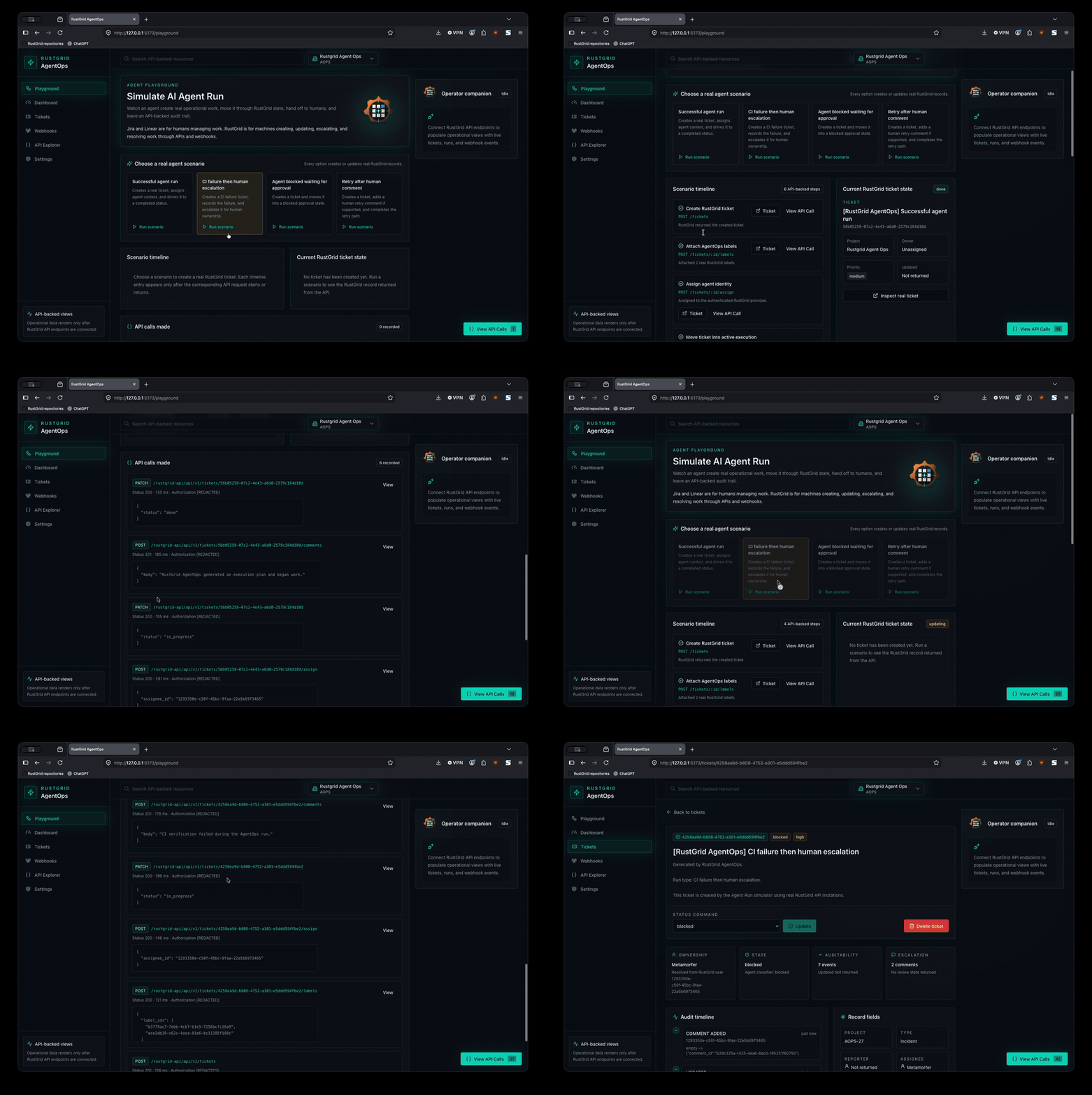
The important part is that the product surface is not a control panel around local demo state. It shows how agent work maps onto RustGrid primitives: mission creation through the current ticket contract, status transitions, comments, project scope, repository state, API-call inspection, and webhook-aware operations.
Agents Need A Workflow Contract
An agent that handles real work needs a stable contract around state.
It needs to know what work exists, what state that work is in, what context has already been added, which actions are allowed, and how to write a result without corrupting the source of truth. That contract cannot live inside a prompt. It has to live in the backend.
The minimum shape looks like this:
- typed create, read, search, update, comment, and transition APIs
- scoped credentials for each agent, worker, and integration
- project and tenant boundaries derived from authentication
- idempotency keys for retried writes
- optimistic concurrency with ETags and
If-Matchwhere stale writes matter - audit history that records the actor, request, previous state, and next state
- webhook events so downstream systems can react without polling
- comments and fields that preserve both human context and machine context
This is the layer that turns an agent from a UI driver into a workflow participant.
The Agent Loop
Most production agent workflows follow a familiar loop.
A signal happens: a support message, failed webhook, security alert, user feedback item, billing exception, or monitoring event. A service creates or finds the relevant ticket. The agent reads the ticket, checks surrounding context, proposes an action, and writes a bounded result back to the system.
In a headless ticketing system, that loop can stay explicit:
- A service creates work near the source of the signal.
- The agent reads the ticket, comments, fields, and related events through APIs.
- The model proposes the next action as structured output.
- Deterministic code validates permissions, state, policy, and freshness.
- The backend commits the change with idempotency and concurrency controls.
- Audit and webhook events describe exactly what changed.
The model can reason. The workflow backend decides what is allowed to become real.
That separation matters because agents retry. Queues redeliver jobs. Humans edit tickets while automations are running. Another agent may be working on the same object. Without a backend contract, every one of those cases becomes a race hidden inside an integration.
With headless ticketing, the conflict is ordinary infrastructure. A stale update can fail with a precondition response. A duplicate create can replay the original result. A permission boundary can reject an agent that is allowed to comment but not allowed to close. The audit trail can show whether the actor was a person, API key, service, or agent.
Tickets Are Agent Memory With Boundaries
People often talk about agent memory as if it belongs inside the model runtime.
Some memory does. But workflow memory belongs in the workflow system.
A ticket is a useful memory object because it is shared, queryable, permissioned, and durable. It carries the current state of a task, the decisions made so far, the people watching it, the services that touched it, and the external events that should be connected to it.
For an agent, that creates a better operating surface than a chat transcript:
- the title says what the work is
- the status says where the work stands
- the priority says how urgently to act
- the assignee says who owns the next step
- the comments preserve reasoning and handoff context
- the audit trail proves what actually changed
- the webhook stream gives other systems a clean way to react
The agent does not need to remember everything. It needs to read the current workflow object, act within its scope, and leave useful state for the next actor.
A Small API Surface Is Enough
The first useful agent integration does not need to be large.
It needs to create a ticket when the signal happens:
curl -X POST "https://app.rustgrid.com/api/v1/tickets" \
  -H "Authorization: Bearer <AGENT_API_KEY>" \
  -H "Content-Type: application/json" \
  -H "Idempotency-Key: agent-triage-webhook-evt_123" \
  -d '{
    "project_key": "OPS",
    "title": "Investigate failed billing webhook",
    "description": "The billing webhook failed after three delivery attempts. Source event: evt_123.",
    "type": "task",
    "priority": "high"
  }'
After that, the agent needs to read the ticket, add context, and move state only when policy allows it. The important part is not that the API is complex. The important part is that the API is stable, scoped, retry-safe, and observable.
This is also where headless beats “AI features inside a PM tool.”
An AI sidebar can summarize a ticket. That is useful. But an agent that is part of production operations needs a narrower and more reliable interface: create the work, read the state, validate the action, commit the transition, emit the event, and preserve the audit record.
Why Scoped API Keys Matter
Agents should not borrow human authority.
An agent that triages support tickets should not inherit the permissions of the support lead who configured it. A release agent should not be able to edit billing settings. A public feedback classifier should not read private incident projects. A customer-facing bot should not close internal tasks.
Scoped API keys make the actor boundary explicit.
Each agent can have only the permissions it needs: create tickets in one project, read assigned work, add comments, transition specific statuses, or emit events to a downstream system. If the agent changes purpose, rotate the key or issue a new one. If it misbehaves, revoke it without disrupting human users.
That is the right mental model: agents are software actors, not invisible extensions of a person.
Headless Ticketing Is The Agent Control Plane
AI will make more work happen outside the traditional project management screen.
Some work will start in product telemetry. Some will start in customer conversations. Some will start in security alerts, incident pipelines, internal tools, and agent runs. The ticketing system still needs to coordinate that work, but it cannot assume the board is the center.
Headless ticketing gives agents a control plane:
- durable workflow state instead of transient chat output
- typed APIs instead of screen scraping
- scoped permissions instead of shared sessions
- idempotent writes instead of duplicated side effects
- ETags and
If-Matchinstead of silent overwrites - webhook events instead of polling
- audit history instead of trust in the prompt
RustGrid is built around that shape. Tickets, projects, comments, custom fields, webhooks, API keys, usage limits, permissions, safe writes, and audit are exposed as workflow primitives that humans, agents, and systems can share.
The RustGrid application is the public proof point: a product surface that lets people watch those primitives support agent work end to end.
Autonomous agents need more than another place to click.
They need an execution platform they can safely call—and humans can confidently govern.